Wondering how to make a flower arrangement without it looking lopsided? Start with a container that suits the flowers, build with greenery first, and keep the finished design about 1.5 to 2 times the container’s height.
If you are still choosing stems, our guide to types of cut flowers is a good place to start.
| Item | Value |
|---|---|
| Finished design height or width, compared with the container | About 1.5 to 2 times (one-and-a-half to two times) |
| Stem trim when you re-cut | About an inch, at an angle |
| Cool storage before arranging | 35-40°F for 3-12 hours |
| Water change | Every two to three days |
| Homemade flower food (one recipe) | 1 quart warm water, 1 tablespoon sugar, 2 teaspoons lemon or lime juice, 3 drops household bleach |
These figures come from Nebraska Extension and Iowa State University Extension. They can change, so check the sources before you rely on them.
Learn the building blocks first
Every arrangement, from a jar of garden blooms to a formal centrepiece, draws on the same elements of design. Iowa State University Extension lists line, space, texture, pattern, form, color and size as those elements. Each flower, leaf and stem shows some of these qualities.
The guidelines for combining them are the principles of design: proportion, balance, dominance, rhythm, harmony, unity and contrast. Four of them matter most when you are starting out:
- Proportion: how the flowers, foliage and container relate in size.
- Balance: the stability you get when the parts are in equilibrium.
- Dominance: emphasis, usually through a focal point that draws the eye.
- Rhythm: visual movement, created by repeating a color or shape, by placing flowers at different levels, or by gradual change such as small to large.
Pick a container and flowers that work together
Almost any container works as long as it holds water, and it should complement the flowers rather than compete with them. Low, oblong dishes suit short, wide centrepieces, while tall bottles or vases suit upright arrangements, according to Iowa State University Extension.
West Virginia University Extension adds that the container should be large enough to hold flowers without crowding the stems and deep enough to hold adequate water. A straight-sided vase supports stems better than a flared rim, and a grid of tape across the top can help hold them in place.
Next, think of your stems as a cast with different jobs, as described by West Virginia University Extension:
- Focal flowers: larger blooms that anchor the design, such as lilies, roses and carnations.
- Line flowers: taller stems with blooms along them, such as snapdragons and delphinium, which help set the overall shape.
- Filler flowers: smaller blooms such as spray roses, baby’s breath and berries that add texture, color and depth.
- Detail flowers: delicate blooms such as sweet peas and cosmos that add airiness and movement.
- Greenery: foliage at the base that holds the flowers in and starts to shape the design.
If a cat shares your home, check the list of flowers safe for cats before you buy.
Get shape, balance and color right
A good arrangement feels visually balanced. Nebraska Extension describes two routes: symmetrical designs use similar flowers and shapes on both sides of a central vertical axis for a formal look, while asymmetrical designs are off-center and reach equilibrium through unequal visual weight. For an asymmetrical shape, use spikes or greenery to form a scalene triangle.
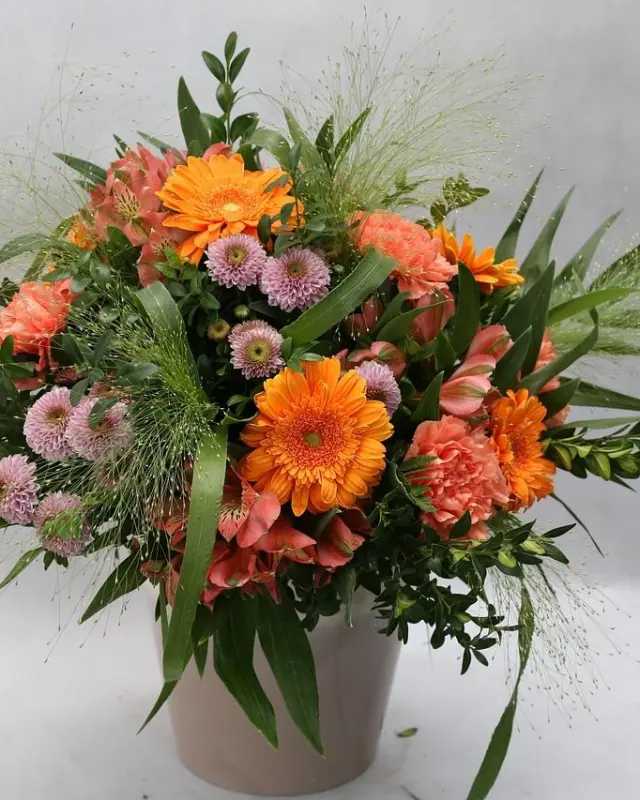
For height, West Virginia University Extension offers a rule of thumb: the arrangement is twice as high as the container, or the container makes up one-third of the overall composition and the flowers two-thirds. Nebraska Extension gives a slightly wider guide of about one-and-a-half to two times the container’s height or width. Either way, consider the room and display area as well.
The same West Virginia guide suggests using odd numbers: no less than three of each flower or element, because odd numbers create a balanced look. It also warns against cramming in a bunch of focal flowers, since you need space as well as blooms.
Color sets the mood. Warm colors such as red, orange and yellow can feel cheerful and energetic, while cool blues, greens and violets often feel peaceful. For a smooth look, pick analogous colors that sit beside one another on the color wheel; for contrast, choose complementary colors from opposite sides, such as yellow and violet.
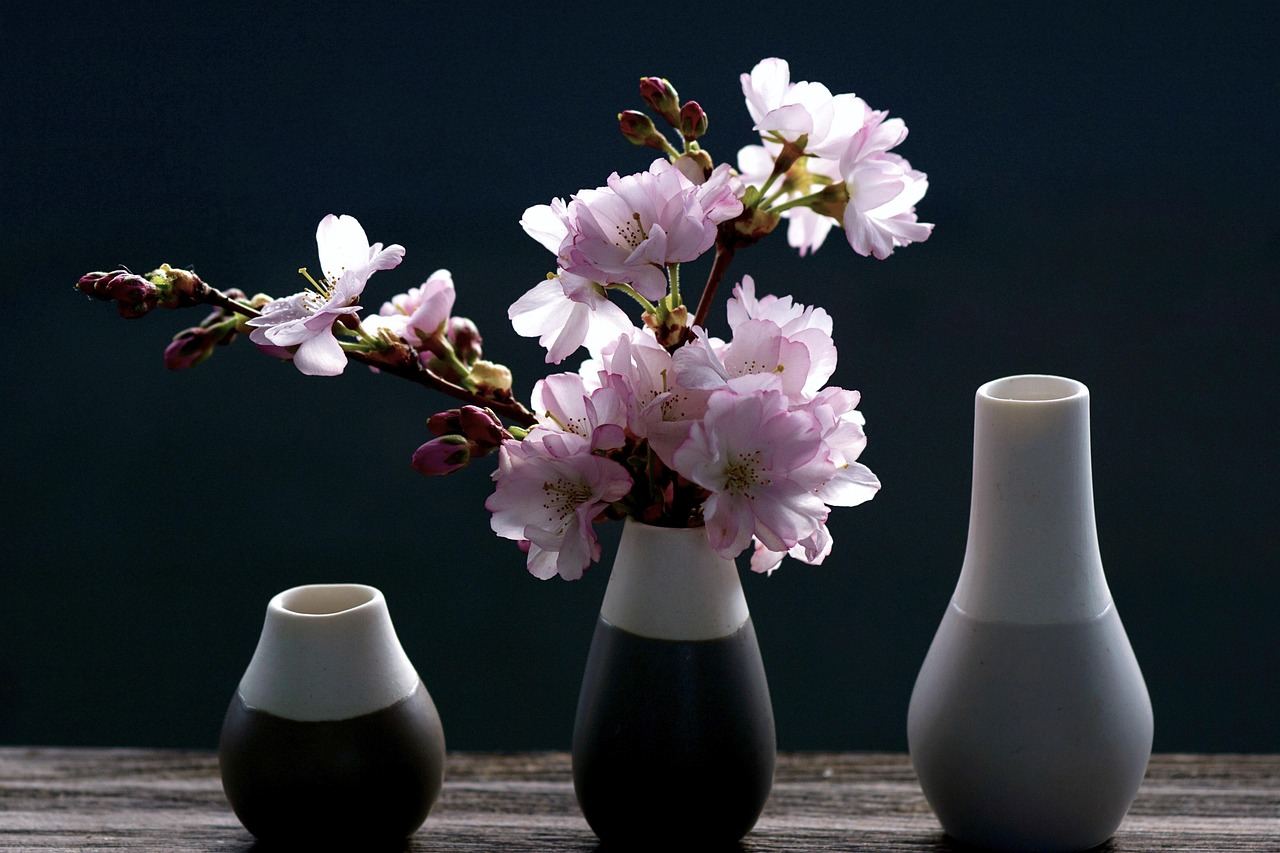
How do you assemble the arrangement step by step?
The order below follows the West Virginia University Extension method, working from large to small. Decide first whether the piece will sit mid-table or against a wall, because that changes how many sides need to look good.
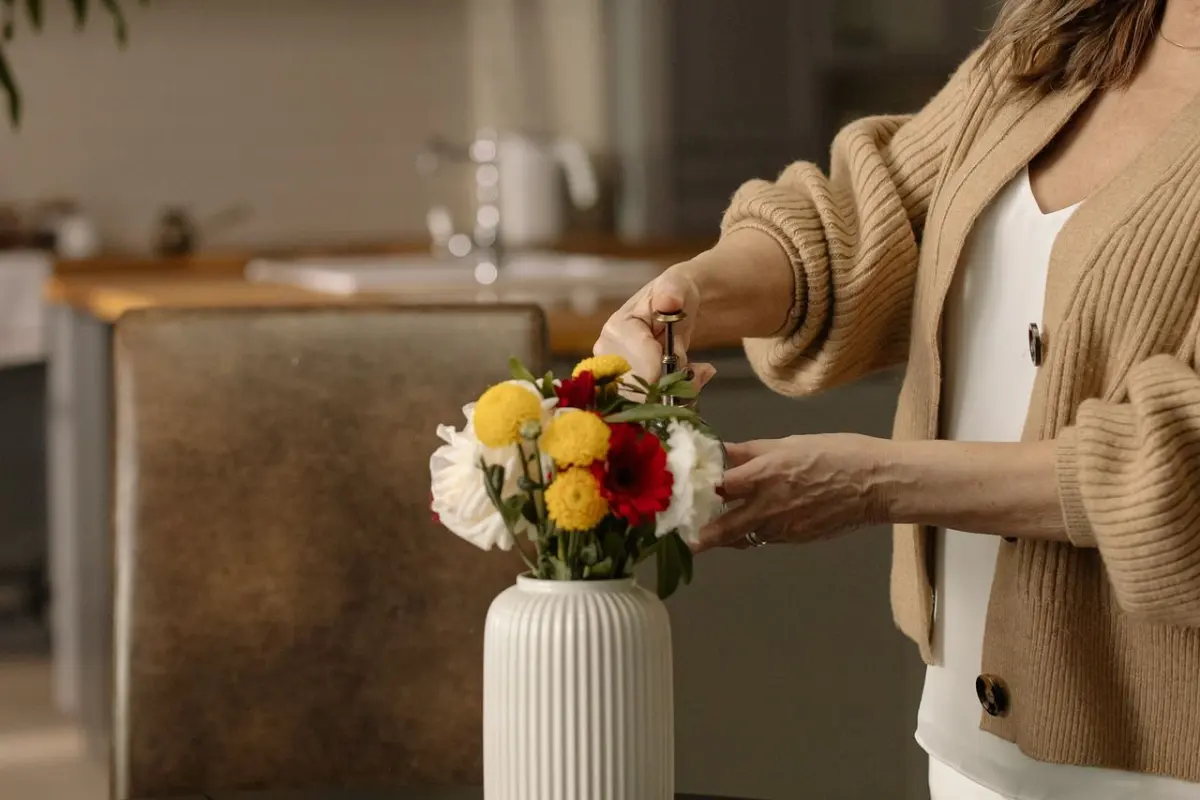
- Remove any leaves that would sit below the waterline. Hold a stem against the vase to judge its height, and always cut less to start.
- Place the greenery in the vase first, enough to hold the flowers and create the shape.
- Add line flowers next to set the overall form.
- Start in the center with focal flowers and work outward, varying their heights and positions.
- Fill large empty spaces with small blooms and filler stems.
- Add delicate flowers last, which helps prevent broken stems.
- Turn the arrangement and tuck in greenery wherever gaps remain.
Condition and care so the design lasts
Good arrangements start with well-handled stems. Cut with a clean, sharp knife, because scissors tend to pinch the stem ends and close off the vessels that carry water, says Iowa State University Extension. Leaves left below the waterline rot, discolor the water and clog stems.
The same source suggests re-cutting stems when you get them home, then storing them in a refrigerator at 35-40°F for 3-12 hours so they take up more water than they lose. Never refrigerate them with fruit or vegetables, which release ethylene that reduces vase life.
Once the arrangement is made, Nebraska Extension recommends starting with a clean vase, trimming about an inch from each stem at an angle, and replacing the water every two to three days. For more ideas, see our piece on how to keep cut flowers fresh longer.
Nebraska Extension also shares a simple homemade flower food:
- 1 quart of warm water
- 1 tablespoon of sugar
- 2 teaspoons of lemon or lime juice
- 3 drops of household bleach
Iowa State University Extension says commercial floral preservatives help extend vase life, while an aspirin or a penny in the water is ineffective.
Frequently asked questions
How tall should an arrangement be compared with its vase?
Show answer
Nebraska Extension gives a general guide of about one-and-a-half to two times the height or width of the container. West Virginia University Extension uses a rule of thumb of twice the container’s height. Check the result against the room it will sit in.
Why use odd numbers of flowers?
Show answer
West Virginia University Extension says odd numbers create a balanced look and recommends no less than three of each flower or element. Odd groupings avoid the stiff, mirrored feel of even pairs.
Do aspirin or a penny keep cut flowers fresh?
Show answer
Iowa State University Extension says these homemade options are ineffective as floral preservatives. It points to commercial preservatives from florist shops, hobby stores or garden centers instead.
Can I use any container?
Show answer
Almost any container works if it holds water. Pick one in proportion to the flowers, deep enough for water and roomy enough that the stems are not crowded.